

Proof of Work
Why Your Resume Is Lying About You (And What to Show Instead)
· 5 min read
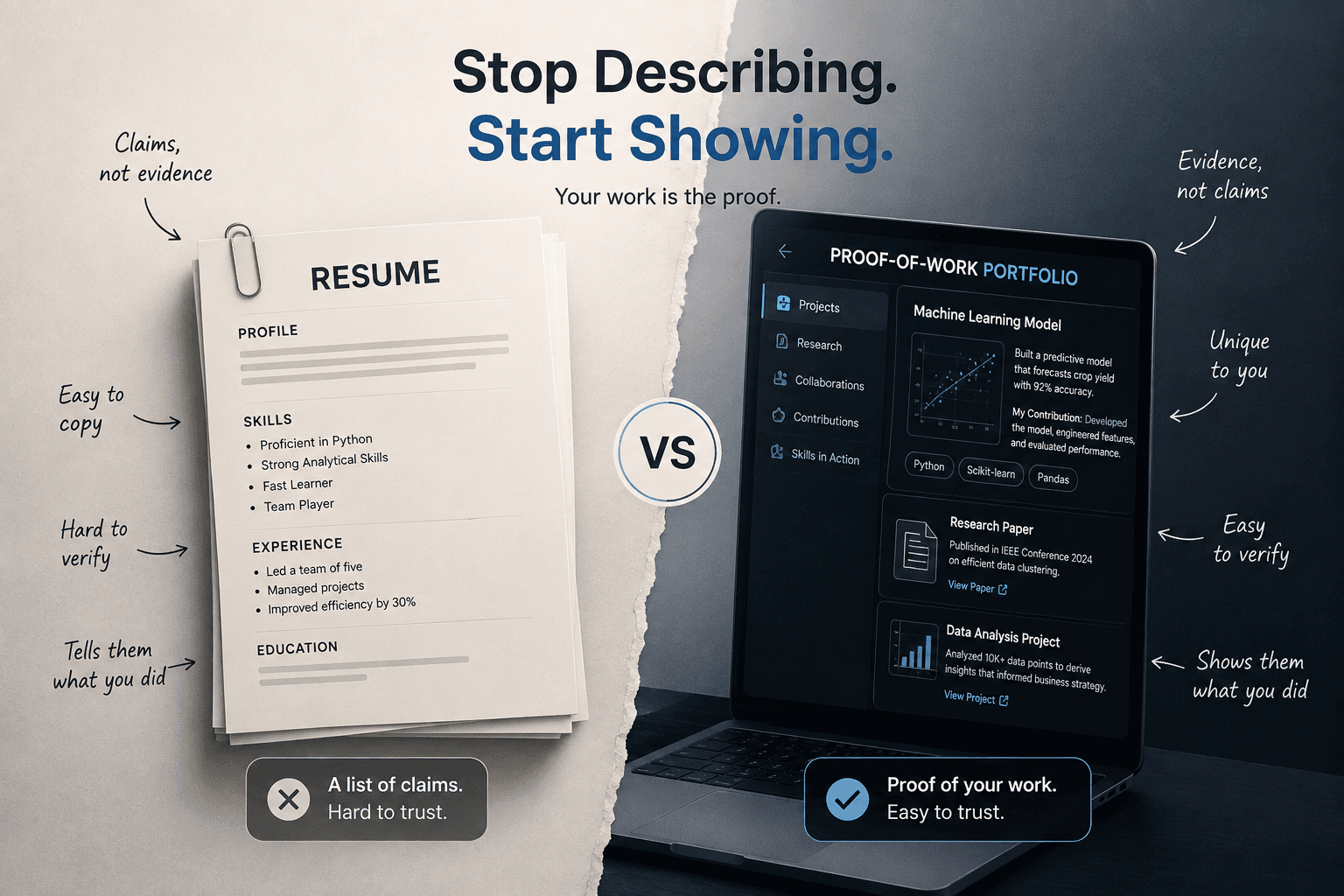
A resume is a list of claims. “Led a team of five.” “Proficient in Python.” “Strong analytical skills.” None of it is evidence. It's a summary someone wrote about themselves, formatted to fit one page, and handed to a stranger who has to decide, in about six seconds, whether to believe it. That's not a hiring process. That's a leap of faith dressed up in Times New Roman.
The strange part is how long we've accepted this. Somewhere along the way, the document became more important than the work it was supposed to describe. This piece is about why that's changing, and what to do about it before everyone else figures it out.
The Resume Was Built for a World That No Longer Exists
The resume format we use today is basically a relic of an era when information about a person was hard to verify and harder to find. A recruiter in 1985 had no way to see your actual work — no GitHub, no portfolio site, no public trail of what you'd built. A one-page summary of job titles and degrees was the best available proxy for competence, so it became the standard.
That constraint doesn't exist anymore. Almost everything a student or researcher does today leaves a trace — code commits, published papers, design files, project write-ups, lab notebooks. The infrastructure to show your actual work now exists. The resume format simply hasn't caught up. We're still using a paper-era proxy in a world where the real thing is one click away.
What Recruiters and Faculty Actually Want to See
Nobody hiring for a role actually wants to know that you're a “fast learner with strong communication skills.” They want to know what you built, what problem it solved, and whether you can do it again for them. Recruiters increasingly skim past the bullet points and go straight to the GitHub link, the portfolio, the project section — because that's where the actual signal is.
The same is true on the academic side. A professor deciding who to bring onto a research project doesn't care as much about your CGPA as about whether you've shown initiative before — a self-started project, a genuine question you pursued, evidence that you follow through. Marks tell you how well someone performs under exam conditions. They tell you almost nothing about what someone does when nobody's grading them.
Proof of Work: The New Currency of Credibility
“Proof of work” is a simple idea: instead of describing what you can do, you show it. A repository instead of “proficient in Python.” A published dataset instead of “strong in data analysis.” A design case study instead of “creative problem solver.” It's verifiable, it's specific, and it can't be inflated the way a resume bullet can.
This shift is already visible in how people build credibility outside traditional systems — developers point to their GitHub, designers point to their portfolio, writers point to their published work. Academia and campus recruiting in India are some of the last places still running almost entirely on the old model. That gap is exactly where the opportunity sits, for students who move first.
What a Proof-of-Work Portfolio Actually Contains
It doesn't need to be a polished showcase of finished, award-winning projects. A real proof-of-work portfolio usually contains:
- Projects with context — not just what you built, but the problem you were solving and the decisions you made
- Contribution, not just output — what specifically was your role, especially in group work
- Process, not just polish — dead ends and iterations are part of the proof, not something to hide
- Collaborations — who you worked with, and what that says about how you work with others
- Links to the real thing — code, papers, designs, datasets — not just descriptions of them
How to Start One This Week (Even With “Nothing” to Show)
Almost every student underestimates what they already have. A college assignment you actually cared about, a half-finished side project, a data analysis you did for fun, a lab exercise you extended past what was asked — these all count. The first step isn't creating new work; it's documenting the work you've already done, properly, with context.
From there: pick one project and write two or three paragraphs about what you built and why it mattered. Link the actual files or code. Ask a professor or teammate for a short line confirming your role. Do this three or four times and you already have more proof than most resumes contain in total.
This is the entire premise behind Collab47 — a place where your projects, collaborations and contributions live as your actual application, connected to the people and institutions who can act on them, instead of sitting buried in a laptop folder or a resume nobody reads past the first line.